THE EVLA VISION: STARS ON AND OFF THE MAIN SEQUENCE
26-28 May 2009, Socorro, New Mexico, USA
Scientific Rationale
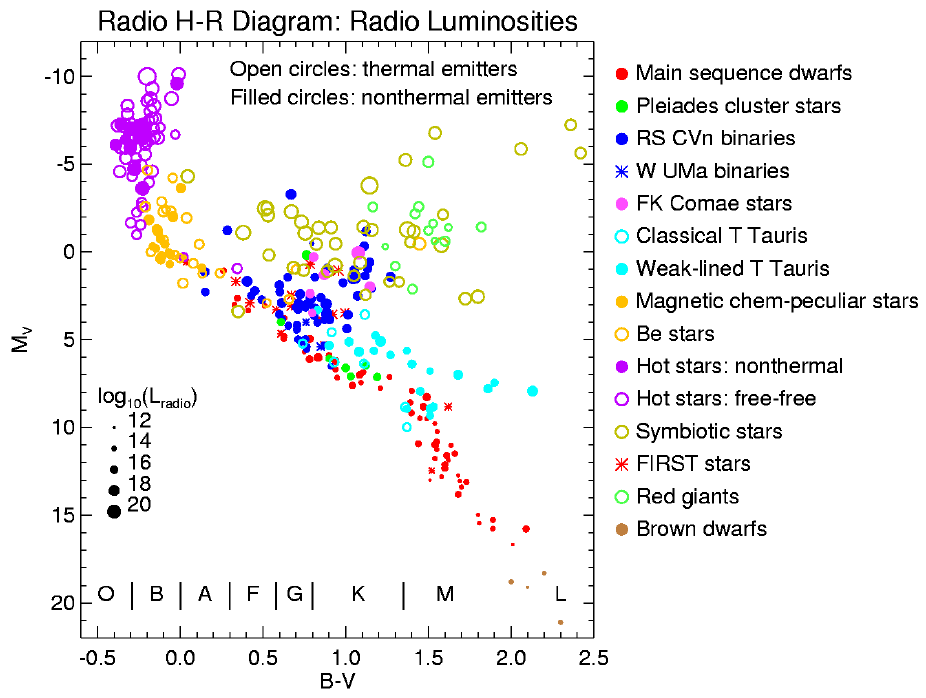
The VLA revolutionized the field of stellar radio astronomy, with
detections across almost the whole Hertzsprung-Russell diagram, and the opening of
entire new fields of research. The EVLA promises similarly impressive advances,
with massive improvements in sensitivity, instantaneous bandwidth, frequency coverage,
spectral capability, and transient source response.
The object of this conference
is to explore what this will mean for studies of stars. Some examples include:
|
Invited Speakers
Confirmed invited speakers (and topics) include:
| Tim Bastian | NRAO | (The Sun) |
| Tracey Delaney | MIT | (Supernova Remnants ) |
| Jan Forbrich | CfA | (Young Stellar Objects) |
| Manuel Guedel | ETH Zurich | (Cool Main Sequence Stars) |
| Laurent Loinard | UNAM | (Proper Motion of Thermal Sources) |
| Tom Maccarone | Southampton | (Compact Binary Stars) |
| Karl Menten | MPIfR | (Circumstellar Envelopes) |
| Rachel Osten | STScI | (Brown Dwarfs and Transient Phenomena) |
| Scott Ransom | NRAO | (Pulsars) |
| Mark Reid | CfA | (Long-Period Variables and Red Supergiants) |
| Luis Rodriguez | UNAM | (Studies of YSOs) |
| Michael Rupen | NRAO | (The EVLA) |
| Alicia Soderberg | CfA | (SNe, GRBs, and Extragalactic Explosive Events) |
| Grazia Umana | INAF | (Luminous Blue Variables) |
| Stephen White | Maryland | (Conference Summary) |
| Albert Zijlstra | Manchester | (Planetary Nebulae) |
Venue
The workshop will be held in the Domenici Science Operations Center of the National Radio Astronomy Observatory, on the campus of the New Mexico Institute of Mining and Technology, in Socorro, New Mexico. A maximum of 80 attendees will be imposed.
Registration
Registration will open on 20 Feb 2009; the deadline for payment and registration is 4 May 2009. The amount of the registration fee is 120 USD. We may be able to waive this fee for some needy students.
Modified on June 22, 2009 by Mark Claussen